
Feeling the heat: cars, drivers and Europe’s new summer normal
Multiple heatwaves hit Europe this year and cars felt them before drivers did. This is what actually happened to vehicles, what AUTODOC's order data says drivers did in response and what's worth doing differently before the next one arrives, because there will be a next one.

What happens under the bonnet during a heatwave
Like us, cars can suffer in the scorching sun
Extreme ambient temperatures put immense stress on a vehicle, forcing its internal systems to work overtime just to maintain normal operations. Drag the thermometer below to see how six key vehicle components react as the temperatures rise and peak.

Cabin
In a full heatwave, the cabin can approach the temperature of the surrounding pavement when parked. Touching the wheel or seats can be genuinely painful.
The cost of vehicle neglect in a heatwave
Don’t let a heatwave burn a hole in your wallet
An AC compressor under strain, a battery on its last legs and a tyre that’s had enough don’t usually need attention on the same day. However, during an intense summer, they can all need it within a few weeks of each other. To demonstrate how much repairs can add up to, we’ve calculated the average market prices (including VAT) of frequently affected parts in July 2026 and that’s excluding professional labour fees.
Average cost of parts in July 20261Source: AUTODOC internal data. Average market prices for selected car parts in July 2026 across Germany, Spain, the United Kingdom, Austria, Italy and France. Prices exclude professional labour costs.
- Tyre: €102 per tyre
- Car battery: €122
- Air conditioning compressor: €275
- Radiator fan: €153
- Blower motor: €90
Total cost of parts: €742+
Once you factor in the costs of professional labour for diagnostics and replacements, the repair bill becomes excessive. It serves as an effective reminder to invest in vehicle maintenance and care throughout the year, particularly in preparation for extreme weather, to help prevent multiple faults.
Hot trends: what flew off the shelves
Three heatwaves seen through the lens of AUTODOC order data
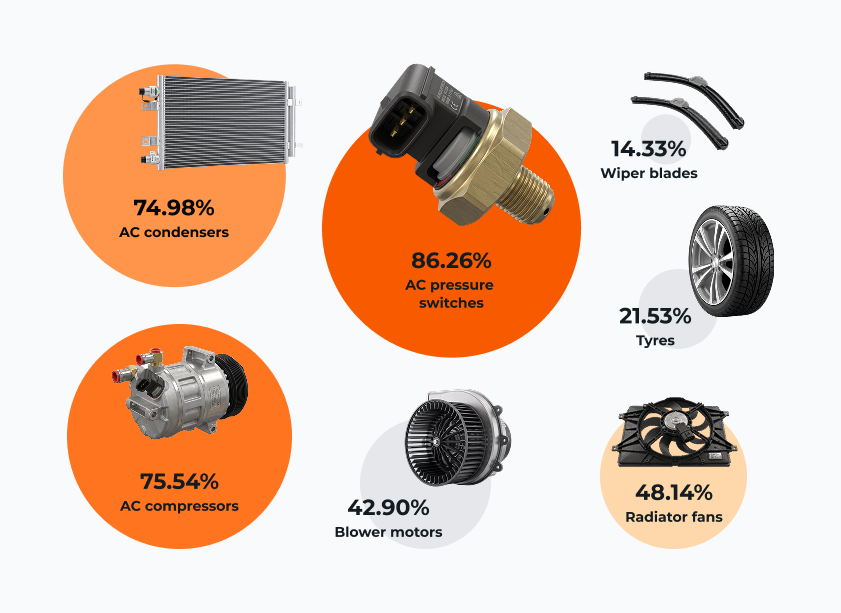
Our platform’s order figures show clear trends in demand for certain parts in the hottest weeks. Air conditioning components typically see the highest growth as a working air con becomes an absolute necessity. This trend is particularly clear when comparing year-on-year order growth for the heatwaves in June and July. For example, orders of AC pressure switches grew by about 86% and AC compressors and condensers by 75% during the heatwave weeks. Radiator fans (50%) and blower motors (43%) were also in high demand.
What was most surprising was the extreme surges in orders for leak detector sprays during heatwave periods, as we calculated a staggering 500% increase for orders in this category. This is likely thanks to increased repairs caused by damaged HVAC pressure lines, tyre valves and air suspension bladders, exposing hairline cracks as pressurised gas escapes.
While consumables like tyres, wiper blades and struts still often see growth, the figures are far less extreme. This is usually because the parts are replaced more frequently and are less dependent on the season.
Order growth for specific parts during heatwaves
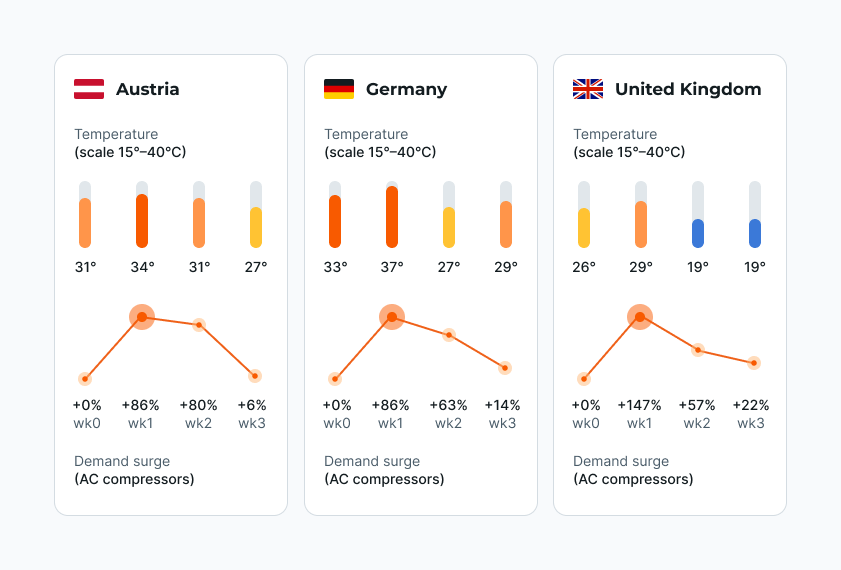
Heatwaves spark a buying surge and crash, not gradual trends
AC part orders surge during heatwave periods, then suddenly crash instead of growing steadily
Take AC compressors as a typical example. In a normal seasonal pattern, demand would climb gradually and stay elevated as long as the heat does. That’s not what happened. Orders jumped sharply in the first week after temperatures rose, stayed elevated for a second week, then dropped back down by week three – even in areas where temperatures stayed high. In this case, the demand curve didn’t follow the temperature curve. It spiked, held briefly and then crashed out.
What the North could learn from the South
A maintenance habit worth borrowing
When explaining the difference in customer behaviour, it’s tempting to assume that people in southern parts of Europe are simply more acclimatised to the heat. The data suggests something more useful. Spain and Portugal don’t get one dramatic heatwave to react to as they see consistently high temperatures all summer long.
As there is no single shocking moment for cars and customers to respond to, the order data doesn’t show such a dramatic spike in the heatwave periods, as the average temperatures and orders stay relatively consistent for months. Put simply: Northern Europe treats heat like a temporary emergency, while Southern Europe treats it like a season.
For a direct comparison, we’ve taken order data from Germany and Spain during these periods, looking specifically at orders for blower motors:
Germany
Weather pattern: average temperatures hit 29°C in Week 22, dropped back down to a cool 23°C in Week 24 and then surged to a sweltering 37°C by Week 26.
Demand pattern: orders jumped to 367 (orders per week) during the first heatwave, but when it cooled in Week 24, demand dropped back to the pre-heatwave baseline. When the second heatwave hit in Week 26, orders spiked again to 382.
Spain
Weather pattern: average temperatures jumped sharply early in the season (19°C in Week 20 up to 31°C in Week 22) and remained consistently in the 30s thereafter.
Demand pattern: demand more than doubled during that initial jump (from 75 to 166 orders). Crucially, even when temperatures fluctuated in the following weeks, demand didn’t drop significantly. When peak temperatures (35°C) hit in Week 26, orders were at 167 – virtually identical to the first spike.
Based on the raw data, the demand for blower motors in Germany was very elastic. It rose and fell dramatically in sync with spikes on the thermometer. In Spain, orders started to rise with the temperatures but remained consistently high from week 22 to week 28.
This supports the idea that once temperatures start to rise, Southern Europe stays in summer mode. The habit worth borrowing is simple: get your car ready before summer is in full swing and maintain it well throughout, not after the first heatwave forces your hand.
So, what can you do now?
The more prepared you are ahead of summer, the less likely you are to experience sudden failures when the heat hits or miss out on a good deal due to spikes in demand in the future. The question is, what can you do now to manage the potential harm that three heatwaves have already caused to your vehicle? To help answer this, we have made a checklist of post-heatwave checks and tips to protect your vehicle from serious faults further down the road.
Check out the AUTODOC checklist here.
About AUTODOC
AUTODOC is the leading digital pure-play automotive parts platform in Europe. Founded in Berlin in 2008, AUTODOC has developed into one of the most exciting e-commerce companies in Europe. An assortment covering over 7.8 million products from 2,700 brand manufacturers spanning a comprehensive inventory of car, heavy vehicle, and motorcycle components, alongside tyres and essential automotive fluids, maintenance consumables, and professional-grade tools. AUTODOC is online in 27 European countries and employs more than 5,500 people in 13 locations.
- 1Source: AUTODOC internal data. Average market prices for selected car parts in July 2026 across Germany, Spain, the United Kingdom, Austria, Italy and France. Prices exclude professional labour costs. ↩︎
Created at 21.08.2026