
Crude realities: Why your oil change costs more this year
Drawing on AUTODOC's own data and market intelligence from 27 countries, AUTODOC Insights takes an expert look into factors affecting car ownership, repair, and maintenance for drivers and professionals.
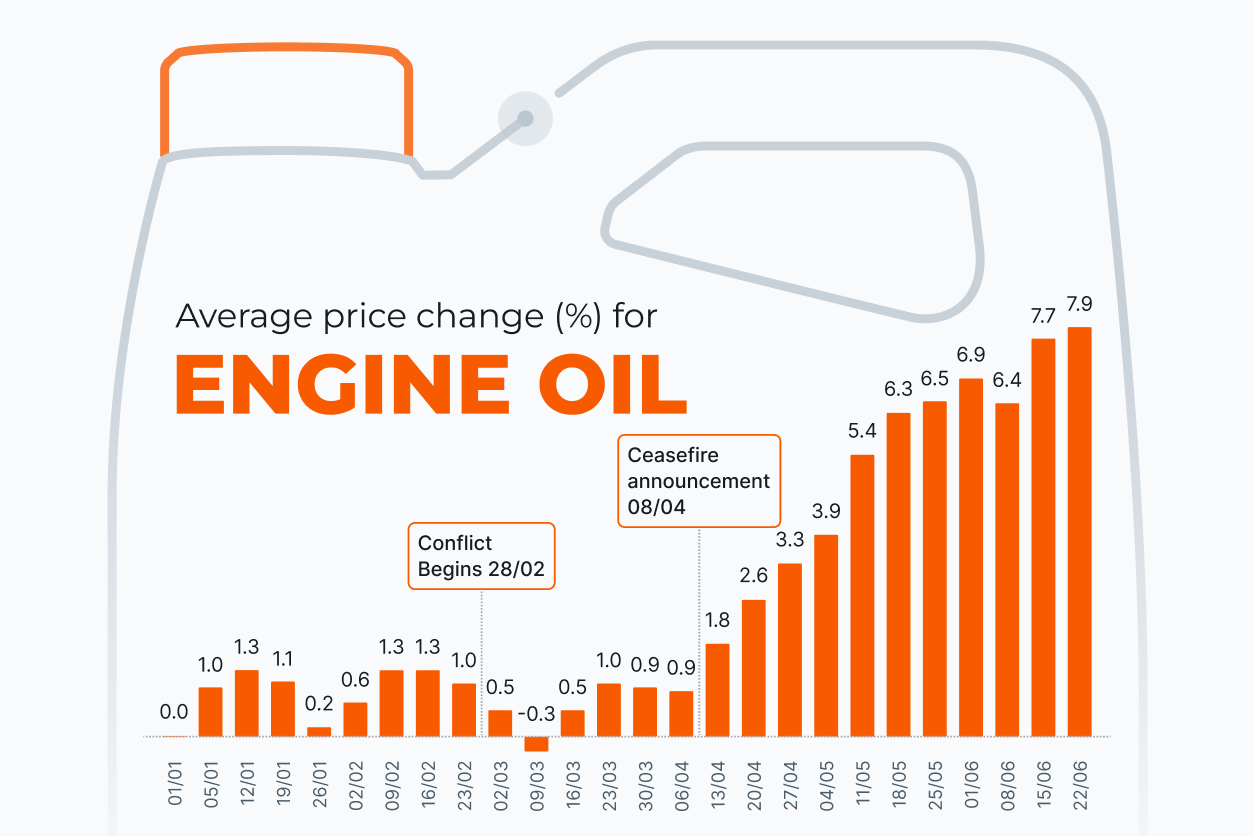
Most of us instinctively understand that a war in the Persian Gulf affects oil prices, but the impact goes further than the pump. Even a routine oil change is now getting more expensive across Europe, though the timing and extent of the increase varies by country. Why?
In this report, AUTODOC looks closely at how European engine oil supply chains and prices were disrupted by the conflict in and around the Persian Gulf in the first half of 2026. We examine our own data and external factors, like the price of crude and closure of the Strait of Hormuz, to see how they affected engine oil prices across Europe.
So much for a simple oil change: engine oil price trends across Europe
Engine oil price change by
country, % change Jan–Jun 2026

UK
+18.3%
Steepest rise of all six markets – up 18.3% by June. Heavy reliance on spot-market pricing left suppliers fully exposed with no buffer.

Sweden
+2.5%
An early spike, with a secondary climb before dropping off again. Strong local Nordic supply networks limited the total increase to a moderate 2.5% at the end of June.

France
+1.8%
Kept prices under control, ending the period with only a 1.8% increase. Long-term contracts, strategic reserve releases, and state-backed buffering insulated consumers.

Germany
+11.4%
A 11.4% rise driven by German consumers’ demand for premium oils. High-specification supply chains had no room to absorb raw material spikes.

Spain
+6.8%
Delayed reaction to the war, remaining flat at first. Expiring contracts and dwindling supplies then triggered a price surge, with a 6.8% increase by the end of June.

Italy
+6.5%
Due to immediate shipping cost increases, suppliers initiated small, regular price bumps in February and May, resulting in a 6.5% total rise by late June.
Average Engine Oil Market Price Change in the United Kingdom, Germany, France, Spain, Italy, and Sweden (January–June 2026). Source: AUTODOC Internal Market Analysis Data (engine oil price trends, weekly data for 2026)
We tracked average engine oil prices for leading brands across Europe during the first six months of 2026, and the trend was clear: prices rose across the board. As the crisis in the Gulf moved from a diplomatic standoff in January to an active military conflict in March, European engine oil manufacturers suddenly found it much more expensive to operate. Across the continent, the response was in two stages. Initially, major suppliers tried to keep prices stable, absorbing the extra shipping costs themselves.
However, as the closure of the Strait of Hormuz became a long-term problem, companies could no longer sustain this. By mid-April, the rising costs of base oils, chemical additives, and international shipping forced price increases across the entire continent. This trend varied between different countries with countries like the UK facing the biggest impact. As we will see, local prices were shaped by various factors, including how nations used their energy reserves. The reaction of individual brands varied as well: while some remained below and around the average price increase. To put this in concrete terms: the price for four litres of a particular brand of engine oil went from £37.17 in the first week of January to £44.56 by early July, a rise of roughly 19.9% in just six months.
Friction and conflict: the causes of the 2026 engine oil price surge
To understand why things changed so quickly, we need the technical and political background: the timeline of events that cut off major supply chains, and an understanding of why modern engine oil still depends so heavily on crude oil.
The real narrow margin: the blockade of the Strait of Hormuz
The uncertainty in the Persian Gulf region caused panic in global energy markets in the first quarter of 2026. By March, the Strait of Hormuz was blocked for most traffic. This strait is the most important shipping route for energy in the world; before the war, about 25% of the world’s oil and 20% of the world’s liquefied natural gas passed through it.
By early June, fewer than 200 ships had passed through the strait since the conflict began – less than 10% of the usual traffic. For Europe, the closure of this route was a major shock. EU countries traditionally relied on this channel for a significant portion of their oil and gas imports. The blockade suddenly stranded millions of barrels of oil meant for European refineries, causing chaos in energy prices. With no easy alternatives, the price of Brent Crude, the standard for global oil pricing, shot past $100 (€86) and eventually reached over $120 (€103) per barrel. This led to shortages and panic buying across the world.
The crude roots of synthetic oil
That little oil light on your dashboard means more than “time for an oil change.” Engine oil is a vital part of the engine’s design. It is meant to reduce friction between moving parts, keep the engine from overheating, and prevent the buildup of dirt or carbon. Without these high-quality oils, modern engines would break down.
There are three main types of engine oil: mineral, semi-synthetic, and synthetic. Synthetic oils are the highest quality and are chemically engineered to work perfectly even under extreme heat. Because of strict European emission rules and the needs of modern high-efficiency engines, synthetic oils now make up over 52% of the European market.
Why does this matter? Because even advanced synthetic oils still depend heavily on crude oil imports. Even though synthetic lubricants are heavily modified at a molecular level, the basic ingredients still come from the oil refining process. This means that any disruption in global crude oil imports immediately makes it harder and more expensive to produce engine oil, which leads to higher prices for drivers.
Brent Crude’s Trajectory
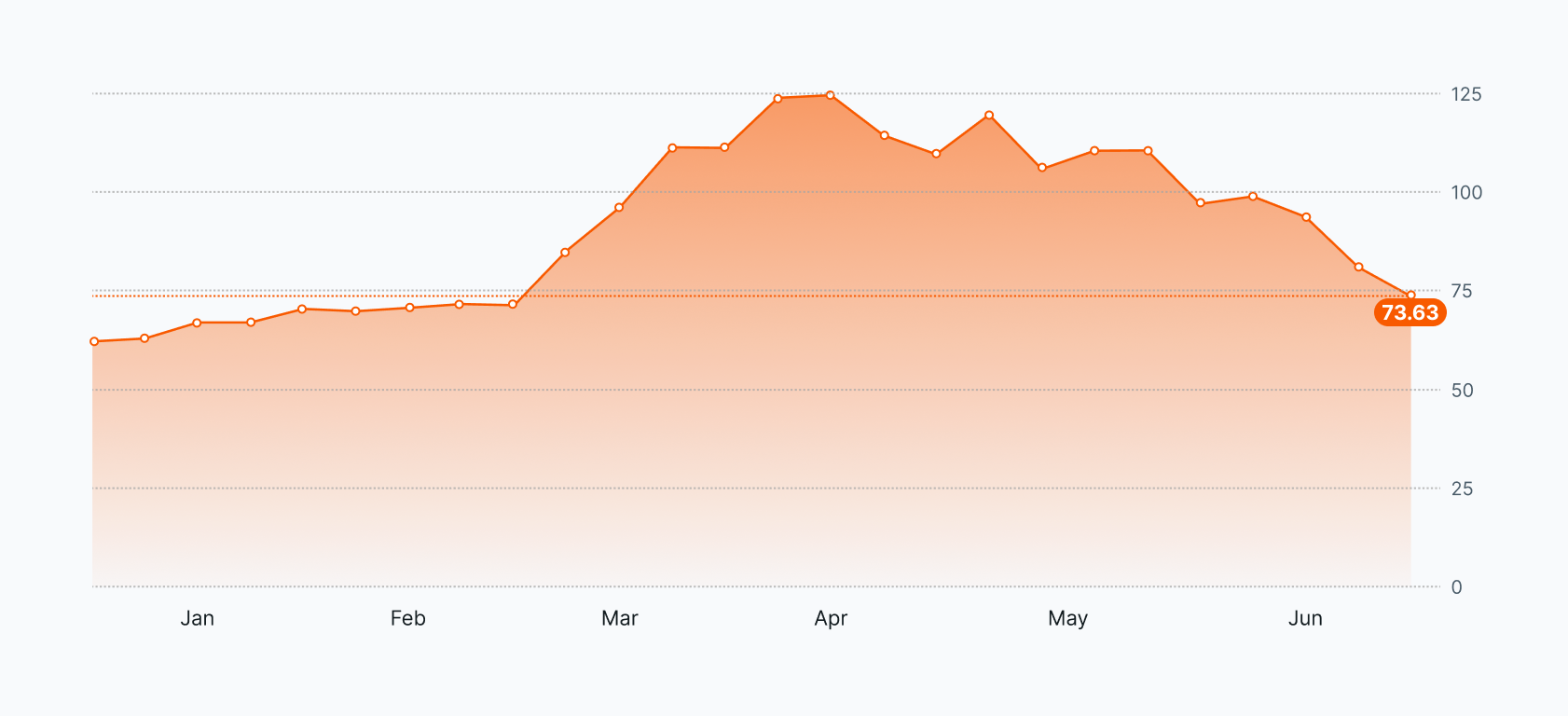
With that in mind, we first have to look at the price trend of the main ingredient for engine oil: crude oil (measured in Europe as “Brent Crude”). As geopolitical tensions grew in February, the price started to creep up, as traders began to worry about the risks.
Once the war between the US and Iran actually started and the Strait of Hormuz was blocked in March, prices exploded. The cost of Brent Crude jumped by over 53% in just one month, reaching nearly $103 (€90) per barrel. This reflected the immediate panic of European refineries that were suddenly cut off from their usual oil supplies. The crisis peaked in April, with prices hitting an average of over $108 (€93) per barrel due to supply fears.
As international agencies stepped in and new, longer shipping routes were set up, the market began to calm down. By May, prices had dropped from their peak to around $91 (€78) per barrel, where they stayed until early June before dropping further. This timeline, a huge price spike in April followed by a period of very high costs, is one of the factors that eventually caused the big price hikes we saw for motor oil in European shops.
Comparing the Brent Crude prices with the average engine oil prices, there is a noticeable point of divergence: Brent Crude peaked in April and was already falling back by May, but engine oil prices didn’t follow it down. Once suppliers had raised prices to cover higher costs, there was little commercial pressure to reverse course quickly. The relief at the crude level didn’t translate into cheaper oil changes for consumers.
An uneven shock: How and why the crisis hit differently across Europe
The crisis hit different countries in different ways depending on their supply chains and how they managed their inventories. In this section, we will take a closer look at how local conditions determined how much prices changed in each country.
Reserves, inflation, and fear: why some countries paid more than others
Three key factors shaped how badly each market was affected.
Strategic buffers: State reserves and corporate strategy
Countries that released national oil reserves or stepped in to protect their industries, like France and Sweden, were able to stabilise their markets and limit price rises. Countries without those buffers in place, like the UK and Germany, were left fully exposed to global price swings.
War shock versus core inflation
Europe was already under economic pressure before the conflict. Eurozone inflation was running at 3.3%, with Germany at 2.7%, Spain at 3.6%, Italy at 3.3%, and the UK at 2.8%. The Strait of Hormuz closure didn’t just push up crude oil; it also drove up factory energy costs, plastic packaging, and freight rates all at once, compounding price rises that were already building. For markets like the UK and Germany, which were already more exposed to spot-market pricing, this double pressure hit hardest.
Supply realities and speculative margins
Our analysis shows that price rises weren’t just driven by supply and demand – fear played an equal role. In the UK, Germany, and Italy, the biggest price jumps happened well before factories actually ran short of raw materials. As soon as the blockade began, suppliers added a risk premium across the board, raising prices early to protect their margins against future costs they hadn’t yet incurred. Psychology, in other words, moved faster than the shortage itself, hitting European drivers’ bills sooner and harder than the physical supply situation alone would have.
A new normal, still being negotiated
Current data suggests the market is reaching a turning point, moving away from the chaotic price spikes of early 2026 toward a more stable phase. The future of engine oil prices in Europe depends heavily on finding a permanent solution to the war and reopening the shipping routes through the Strait of Hormuz.
As Anton Dmytrenko, Senior Competitive Intelligence Manager at AUTODOC notes:
“Even though European engine oils market data shows slightly different behaviour depending on region […], the global trend of lubricant prices is leaning towards an increase compared to the baseline in early 2026.”
As the initial panic dies down and supply chains adjust to longer routes around Africa, manufacturers are starting to find their footing. Dmytrenko adds that the crude oil market had already priced in the possibility of war before it began, pushing crude above $100 in anticipation, and that prices moved into a correction phase with a slight increase shortly after the conflict’s hot phase started. He expects a similar pattern to play out with engine oil: suppliers held prices initially to project stability, then raised them to recover losses and protect margins, and the next phase should bring a move back towards price ceilings, a correction with a noticeable drop, and small consecutive increases settling at a new baseline, one that will shape global market prices going forward.
The shocks caused by the 2026 US-Iran war and the blockade of the Strait of Hormuz spread quickly and unevenly across Europe. While markets like the UK and Germany faced massive price hikes, countries like France and Sweden used their reserves and inventory strategies to handle the crisis better, while others took advantage of the chaos to adjust their own prices.
As a major player in the market, AUTODOC concludes that the combination of supply issues, inflation, and market fear has created a new, higher standard for prices. People involved in the car industry across Europe must now move past just managing the crisis and adapt to this changed global market.
About AUTODOC
AUTODOC is the leading digital pure-play automotive parts platform in Europe. Founded in Berlin in 2008, AUTODOC has developed into one of the most exciting e-commerce companies in Europe. An assortment covering over 7.8 million products from 2,700 brand manufacturers spanning a comprehensive inventory of car, heavy vehicle, and motorcycle components, alongside tyres and essential automotive fluids, maintenance consumables, and professional-grade tools. AUTODOC is online in 27 European countries and employs more than 5,500 people in 13 locations.
Created at 09.07.2026